
The core difference is simple: in coach-pitch, an adult (usually a coach or parent volunteer) throws underhand or overhand to their own team’s hitters, while in machine-pitch, a pitching machine delivers the ball at a fixed speed and location. Both formats exist to bridge the gap between tee-ball and kid-pitch, giving young hitters more realistic timing without the wildness of 7- and 8-year-olds pitching to each other. The right choice usually comes down to league rules, the age group, and how consistent you want the strikes to be.
Why baseball uses a “bridge” format at all
Tee-ball teaches contact off a stationary ball, but it doesn’t teach timing. Kid-pitch, where players pitch to each other, sounds like the natural next step, but at 6, 7, or 8 years old, command is inconsistent enough that games can turn into a parade of walks and hit-batters rather than actual at-bats. Coach-pitch and machine-pitch both solve this by handing pitching duties to someone (or something) that can reliably get the ball near the strike zone, so kids can focus on swinging the bat and learning the game’s flow — running bases, fielding position, understanding outs. If you’re mapping out where these formats sit in the bigger picture, our guide to Little League divisions and age brackets lays out how coach-pitch, machine-pitch, and kid-pitch typically line up by age.
How coach-pitch works
In a coach-pitch setup, a coach — often from the batting team — stands at or near the mound and pitches to their own players. The pitcher position on defense is still filled by a player, but that player usually isn’t the one throwing to the plate; some leagues have a defensive “pitcher” standing to the side or slightly off the mound for safety, since balls come back through the middle at a young age with unpredictable reactions.
Because a real person is throwing, coach-pitch has some built-in flexibility:
- The coach can vary the speed and location slightly to match a batter’s comfort level, speeding up as kids get more advanced.
- Coaches often get a few “reset” pitches if a batter completely misreads timing, keeping the at-bat productive rather than punitive.
- It keeps an adult actively involved in every at-bat, which some leagues value as a coaching and mentoring moment as much as a competitive one.
The tradeoff is consistency. Even experienced coaches can’t repeat the exact same pitch over and over, so hitters see more variation in speed, arm angle, and location than they would from a machine.
How machine-pitch works
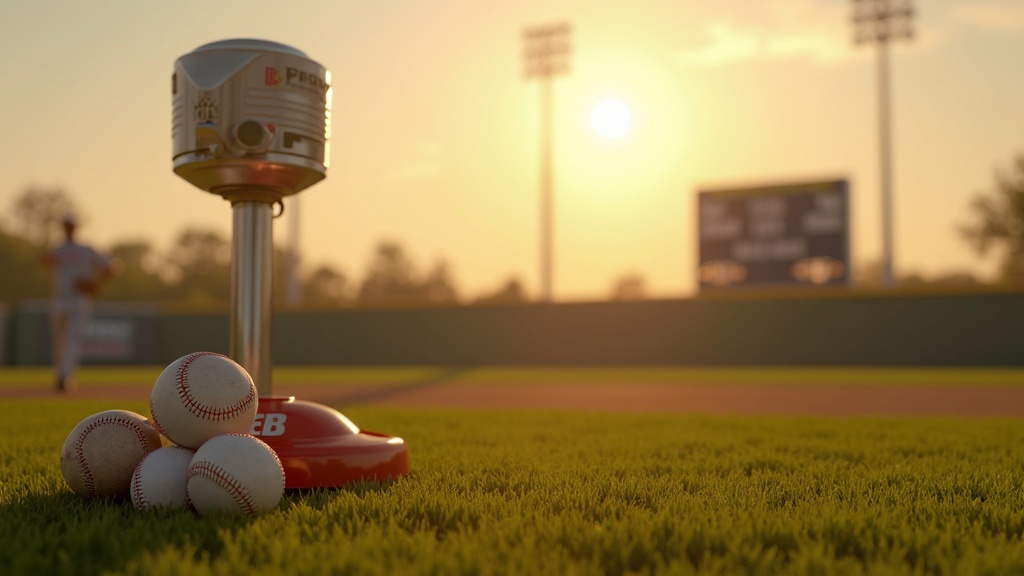
Machine-pitch removes the human variable. A pitching machine, usually set at a fixed speed appropriate for the age division, delivers pitches from a set distance, and the defensive pitcher — a player — stands near the machine to field and back it up. Some leagues have that player stand beside the machine rather than in front of it for safety.
The appeal of machine-pitch is repeatability. Because the machine throws the same pitch, at the same speed, from the same release point, hitters get a much more consistent look at every at-bat. That consistency can help kids groove their swing mechanics and timing without the guesswork of reading a different arm slot from every coach’s kid who steps up to throw. It can also feel more “grown-up,” since it starts to resemble what real pitching looks like — a single release point the batter has to time up.
The tradeoff is that machines are mechanical, and mechanical things need setup, maintenance, and someone comfortable operating them. Younger players sometimes find the fixed speed intimidating at first, and there’s less room to “coach” the pitch to a struggling hitter mid-at-bat the way a person can.
How the big programs define these formats
- Little League: coach pitch and machine pitch are formats inside the Minor League division, which is open to league ages 7–12, and to ages 5–6 after one regular season of Tee Ball. Little League sets the pitching distance at 46 feet for the Major Division and below (League Age Determination, Field Specifications).
- PONY: Pinto 8U comes in three flavors: coach pitch, machine pitch and player pitch. Pitching distance is 38 feet for coach pitch and machine pitch and 40 feet for player pitch, with 60-foot bases and a mound of 4 inches (PONY Pinto 8U). PONY’s page recommends coach-pitchers or a pitching machine if a community has no Shetland league.
- Cal Ripken (Babe Ruth League): the Rookie level is designed primarily for ages 7–8 and uses a pitching machine; Tee-Ball covers ages 4–6. Babe Ruth League says these age groupings are recommendations and local leagues set their own (2026 Local League Guide).
Which division a particular child falls into depends on the program’s age cutoff; use our league age finder to check.
Coach-pitch vs machine-pitch at a glance
| Factor | Coach-Pitch | Machine-Pitch |
|---|---|---|
| Who delivers the pitch | An adult coach or volunteer | A pitching machine |
| Consistency of pitches | Varies by coach’s arm and mood | Very consistent speed and location |
| Flexibility for struggling hitters | High — coach can adjust on the fly | Lower — settings are usually fixed for the at-bat |
| Feel of the game | More personal, mentoring-focused | Closer to a “real” pitching look |
| Equipment/setup needed | None beyond a ball and coach | Machine, power source or arm-load system, setup time |
| Typical age range | Often the younger end of the bridge divisions | Often the slightly older end, right before kid-pitch |
Which one is “better” for a young player?
Neither format is objectively superior — they’re tools that serve different purposes, and plenty of leagues run both in sequence as kids age up. Coach-pitch tends to suit the very newest hitters, since a patient coach can slow the pace down, adjust to a nervous batter, and keep the at-bat encouraging rather than frustrating. Machine-pitch tends to suit hitters who’ve got the basics down and are ready to time up a truly consistent pitch, building toward the day a real kid-pitch pitcher is on the mound.
If you’re a parent trying to figure out what your league actually uses and why, it’s worth checking your specific league’s rulebook rather than assuming — divisions and formats can vary by region and by season, and exact age cutoffs are set by the local league or association rather than by baseball nationally. Little League International and USA Baseball both publish general guidance on divisional structure that can help you understand the reasoning behind the format your child’s league has chosen.
It’s also worth remembering that both formats are stepping stones. The goal isn’t to “master” coach-pitch or machine-pitch forever — it’s to build enough comfort with timing, contact, and base running that the transition to kid-pitch feels like a natural next step rather than a shock. Parents gearing up for that next level often find it helpful to read up on what tryouts and evaluations look like once a child moves into more competitive play; our parents’ guide to baseball tryouts covers what evaluators tend to look for.
Gear considerations for coach-pitch and machine-pitch players
Because these divisions still involve real contact hitting and infield reaction plays, glove fit matters more than parents sometimes expect at this age. A glove that’s too big or stiff can slow down a young fielder’s reaction time on a sharply hit ball off a machine or a coach’s fastball-lite. If you’re shopping for this stage, our youth baseball glove size guide walks through sizing by age and position so you’re not guessing at the store.
Bats matter too, though league rules on bat specifications (barrel diameter, drop weight, certification marks) vary and change over time, so it’s always worth double-checking your specific league’s current bat rules before a purchase rather than relying on last season’s list.
How this fits into the bigger youth baseball picture
Coach-pitch and machine-pitch are just two stops along a much longer path that includes tee-ball, kid-pitch, travel ball, and eventually high school and beyond. If you’re weighing whether to move beyond house-league ball at some point, our overview of what travel baseball is and whether it’s right for your kid is a useful next read, as is our breakdown of what travel baseball actually costs, since that’s often the bigger decision families face once a player outgrows the coach-pitch and machine-pitch divisions. For the full landscape of youth formats, rules, and age brackets, our Youth & Travel Baseball section is the hub to browse.
And if your family is just as curious about how the sport’s rules work at the highest level, it’s worth a look through our Rules Explained section — plenty of parents find that understanding things like the strike zone or the balk rule makes watching their own kid’s games more fun, too.
Frequently asked questions about coach-pitch vs machine-pitch
What age is coach-pitch usually for?
Coach-pitch is typically used for the younger end of the “bridge” age range, right after tee-ball, though exact ages vary by league. Check your specific league’s divisional chart rather than assuming, since cutoffs differ by region and organization.
What age is machine-pitch usually for?
Machine-pitch is often used slightly later than coach-pitch, as a step just before kid-pitch begins, but again this varies by league and region. Your local league’s rulebook or website will have the exact age bracket used in your area.
Is machine-pitch harder than coach-pitch?
It can feel different rather than strictly harder — machine pitches are more consistent in speed and location, which some hitters find easier to time up once they adjust, while others find the fixed pace less forgiving than a coach who can slow things down for them.
Do coach-pitch and machine-pitch use different field dimensions?
Field and pitching distances can differ by division and league rather than by pitching format alone, so it’s best to check your specific league’s field setup rather than assume coach-pitch and machine-pitch always use identical distances.
Can a league use both coach-pitch and machine-pitch in the same season?
Some leagues do offer both as options within the same age group, letting families or divisions choose, while others use one format exclusively at a given level. It comes down to local league policy, so checking your league’s website or asking a board member is the most reliable way to find out.
Baseball Place publishes general information for players, parents and coaches. This isn’t coaching, medical or safety advice, and pitch counts, training loads and return-to-play decisions vary by age and individual. For arm health, injury or conditioning questions, check current guidelines from USA Baseball or Little League International, or talk to a certified coach or athletic trainer.
Reviewed against primary sources on October 3, 2026. We added the program definitions that day. Sources: Little League · PONY Pinto 8U · Babe Ruth League guide. Drafted with AI assistance; see our editorial policy.